Warning Signs of Suicide


Suicide

I was married to a man who threatened to commit suicide if he didn’t get his way.  More than once. In our very short marriage, the emotional rollercoaster took everything out of me. You cant imagine what this does to a person’s psyche. I didn’t know it at the time, but came to realize, he was a Narcissist. His behaviors were extreme. This blog has some amazing resources, if you suspect you are in a relationship with a Narc.

Suicide is incredibly serious. Since Miss USA Cheslie Kryst’s death, I have watched several interviews with people in her circle. No one saw it coming. Almost all expressed dismay, at the thought of possibly missing the signs. Depression and Suicide are closely linked. In my line of work, we are required to ask about suicidal and homicidal ideation and intention, during every substantive encounter. 

Sadly, Suicide is the tenth leading cause of death in the US. Stats show nearly 50,000 suicides, and more than a million attempts. It appears that 70% of suicides are committed by white males, but more women attempt suicide than men. In general, the younger someone is, the less likely they are to commit suicide. Even so, there seems to be an onslaught of young people now taking their own lives. While some suicides are out of the blue, very often there are warning signs. Unfortunately, these warning signs often go unnoticed or worst, ignored.

Be aware of these common suicide warning signs, and you may save a life:

  1. Feeling hopeless. If someone is miserable and doesn’t believe there’s any hope of a better existence, suicide can be a logical conclusion for them. One possible cure for hopelessness is to prove that the ability to alter the future exists. For example, set one small goal; five pushups or to lose two pounds. Accomplishing a small goal is a way to prove that the future is alterable.
  2. Lack of interest in activities that were once pleasurable. This is one of the primary signs of depression. For instance, if you, or someone you know, has always loved to watch baseball, it would be unusual to suddenly lose interest in that activity.
  3. Talking about suicide. Many people that are considering suicide mention it at some point. If you know someone that seems interested in the topic of suicide, that’s potentially a serious warning sign. They might ask you how you’d commit suicide, mention it in the news, or even ask your opinion of people that have done it.
  4. Intentional isolation. People who drastically reduce their social interactions are often also contemplating suicide. When people are miserable, they tend to isolate themselves from everyone else in the world. If your normally sociable friend rarely makes an appearance, there could be an issue.
  5. Giving away possessions. People considering suicide can still be concerned about who receives their possessions when the smoke clears. They often start giving away their tools, furniture, pets, and anything else of value.
  6. Depression. Depression is a primary warning sign of suicide. Remember depression is treatable. There’s no reason to suffer passively, when there are so many treatment options available.
  7. Strong feelings of guilt or shame. People who commit suicide are frequently overwhelmed with feelings of guilt or shame. The best way to deal with these two emotions is therapy. Fortunately, there are many free resources available for this issue as well. An online search will turn up several good possibilities. 
  8. Saying goodbye to friends and family. Committing suicide is like taking a very long trip that you never come back from. Most of us wouldn’t leave on a long trip without saying goodbye. If it feels like someone is giving you a farewell for no apparent reason, that could be a warning sign of an impending suicide.
  9. Stating that others would be better off without them. Many people consider suicide, but decide against it because of the harm they realize it could cause to others. When someone believes that others would actually benefit from their death, that’s a serious warning sign that they intend to harm themselves.

Be on the lookout for these warning signs. Given the prevalence of suicide attempts in this country, you may know someone that will attempt suicide. You’ve likely known others that have considered it, whether you realize it or not.

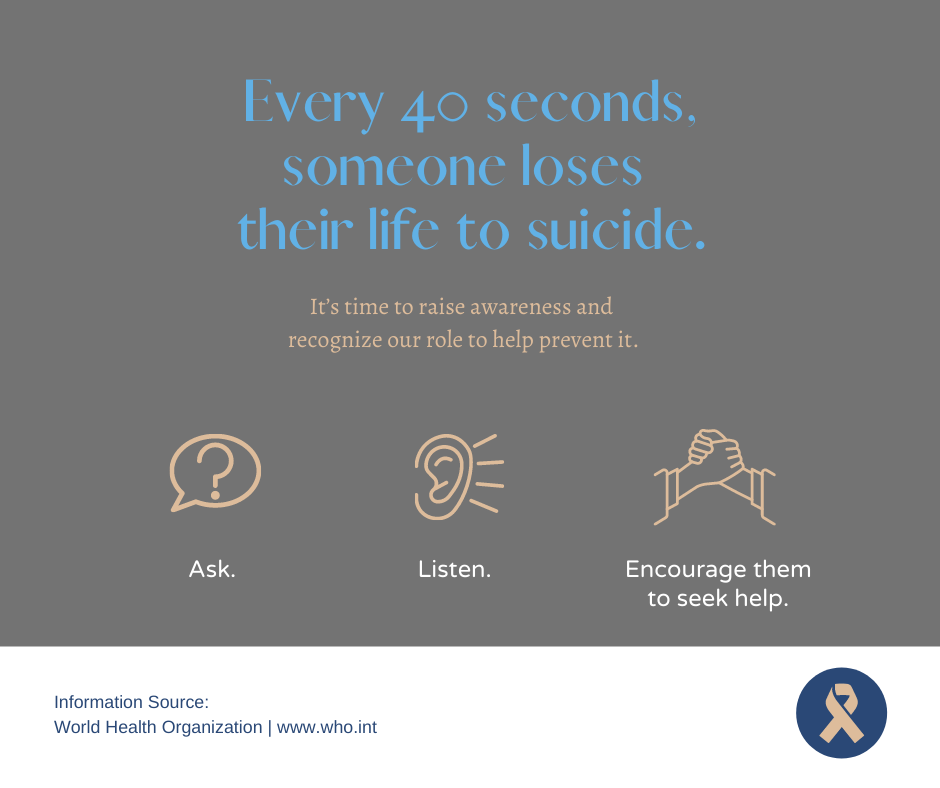
Suicide is a significant cause of death. If you know the warning signs, you might be able to stop yourself, or someone you know, from ending their life needlessly. Ask, listen, and encourage them to seek help. The number for Suicide and Crisis Hotline is 1800 273 8255. 

If you have suffered the loss of a loved one, use this Depression and Loss worksheet, to help you work through your feelings

To Your Success,
Juan
What Is Depression?


March babies, how are you?!

Wishing you a year filled with happiness, contentment, and more joy than you could ever hope for.

Let’s continue the mental health series, this month the focus is on  Depression.

Shortly after Mss USA 2019 Cheslie Kryst’s death, her mom April Simpkins, released a statement which reads in part “While it may be hard to believe, it’s true. Cheslie led both a public and a private life. In her private life, she was dealing with high-functioning depression which she hid from everyone — including me, her closest confidant — until very shortly before her death.” Are you, or someone you know suffering from high functioning Depression? Given all that’s happening in the world, now is not the time to sweep things under the rug. Cheslie’s suicide is a wake up call. Should be.

If you ask a group of people who suffer from clinical depression to define the illness, you’ll get a variety of answers. Depression is a very personal experience, faced by millions. Different people manifest different symptoms. One thing remains clear: depression is a difficult illness, that can destroy your life if left unresolved.

Many people with depression, describe it as a sense of despair, that engulfs everything they do and feel. If you think being depressed is akin to feeling sad, because your favorite team just lost the championship game, you really have no idea, what suffering from this debilitating mental illness truly is. Depression is much deeper, more invasive than sadness or frustration.

Depression takes everything away from you; saps your energy, focus, concentration, and especially your joy. You don’t care about anything; nothing matters, and even people you love can become unimportant. If you’ve felt  depressed for a long time, you become accustomed to the feeling, and any other emotion becomes unfamiliar, and frightening. 

Physical Concerns of Depression
Depression doesn’t only take its toll on your emotions, and mental state; it can cause serious physical problems. You can lose your appetite or eat incessantly. It zaps your energy and motivation. When you’re depressed, you tend to become inactive. This alone can lead to a number of problems, but when added to other physical side effects, it’s easy to see why depression should always be given the care and concern it deserves

In addition, depression can lead to:

  1. 1. Lack of sleep. Insomnia strips the body of the necessary sleep, needed to function properly.
  2. 2. Poor nutrition. When depressed, many people fail to take in proper nutrients. It takes too much effort to plan and prepare a meal. 
  3. 3. Aches and pains. If anyone tells you that your mental state has no effect on your physical state, they are wrong. When you’re depressed, the chemicals in the brain that signal pain, and happiness, are affected in the same way. Physical aches and pains increase, sad feelings kick in, repeating the cycle.
  4. 4. Hygiene issues. Someone suffering from depression doesn’t have the energy or the motivation to be concerned with self-care.

What are the Symptoms of Depression?

  •  Constant and severe sadness about everything
  •  Hopelessness
  •  Insomnia or trouble sleeping
  •  Irritability
  •  Trouble concentrating
  •  Loss of interest in things that once interested them
  •  Feeling worthless, useless and strangely guilty for no reason at all
  •  Serious change in weight, one way or the other
  •  Lack of energy and fatigue

Depression is a serious condition and should be treated as such.
As depression progresses, it feeds on itself like a rolling snowball. The longer someone is depressed, the worse it gets, until they see no way out.  It is not uncommon to resign yourself  to being miserable all the time. Depression can be caused by a certain event, change of seasons, loss of someone close, or even a chemical imbalance in the brain. Treatment usually involves counseling or medication that helps alter brain chemistry. 

If you know someone who is depressed, one of the most important things you can do, is to be his or her friend. Talk to them and help them through this period. Help them seek medical care to treat their illness. If you think you may be depressed, talk to a health care provider. Depression doesn’t have to ruin your life! With support, you can move past it, and go on to live a joyful life. 

Download this  FREE copy of a Depression Checklist. Take it with you when you visit your medical provider, especially if the feelings have laster more than two weeks

You Your Success
Juan

What You Need to Know About Health Anxiety


When you’re living through a pandemic, it’s natural to pay more attention to any symptoms that seem suspicious. However, if these concerns are interfering with the quality of your life, you may be experiencing health anxiety.

That’s the modern name for what used to be called hypochondria. It often starts in early adulthood and grows more serious as you age. You may be convinced that you have one or more major illnesses, even if lab tests and other evidence prove otherwise. Health anxiety varies in intensity. You may be able to put your mind at rest with some effort on your own, or you may need to seek professional care. Try this guide for understanding your options.

Medical Care for Health Anxiety:

  1. Consider counseling. Health anxiety is often connected to other disorders, including other forms of anxiety. You may benefit from cognitive behavior therapy or similar methods that can help you address your overall well being.
  2. Take medication. Talk therapy may be enough, or your doctor may prescribe drugs. That could include antidepressants and anxiolytics that reduce anxiety.
  3. Communicate clearly. If you tend to exaggerate your symptoms, it may be difficult for your doctor to assess your condition. Keeping a journal may help, or you could ask a spouse or partner you live with to share their observations.
  4. Explore family history. You may be more prone to health anxiety, if you or a family member had a serious illness while you were growing up. Let your doctor know if this could be a factor.
  5. Seek appropriate care. While many patients with health anxiety spend too much time at the doctor’s office, others go the other extreme. If you’re afraid of finding out you have an illness, keep in mind that early diagnosis can often give you the best possible outcome.

Self Care for Health Anxiety:

  1. Educate yourself. Maybe you perceive ordinary experiences as being more dangerous than they really are. Learning about common minor ailments could help you keep things in perspective, when you have a headache or an upset stomach.
  2. Limit online searches. On the other hand, maybe you’re overwhelmed from reading too many medical sites. Take a break and find other pastimes. Like you, I have Googled my symptoms when I felt unwell, and convinced myself it was time to get my affairs in order.
  3. Help others. Shifting the focus away from yourself is one of the most effective and constructive distractions. Volunteer at a food bank or animal shelter in your area. Start a community garden in your neighborhood. Find a cause you can get behind.
  4. Manage stress. Chronic tension can aggravate any condition, including anxiety. Try to think positive. Experiment with relaxation techniques to find what works for you. Listen to music, or book a massage.
  5. Be active. Do you avoid doing things you used to enjoy because you think you’re not strong enough? Encouraging yourself to stay engaged could lift your spirits and help you to be more realistic about your abilities.
  6. Sleep well. Anxiety interferes with sleep, and sleep deprivation leaves you feeling out of sorts. Make it a priority to stick to a consistent bedtime that gives you 7 to 8 hours of rest each night. Limit alcohol and caffeine, especially later in the evening.
  7. Breathe deeply. For fast relief, practice breathing exercises that can calm you down or give you energy.
  8. Build support. Let your family and friends know how they can help you. Talking with someone you trust may help you deal with emotional issues that could be contributing to your health anxiety.

If you think you or a loved one may be troubled by excessive and irrational health concerns, talk with your doctor. An effective treatment plan can help you to take care of your mental and physical wellbeing and enjoy life more.  The next three posts will offer ways and tips to help family members with anxiety. Look forward to having you.

To Your Success,
Juan


Develop The Growth Habit Mindset


Readers,

Have you ever considered the flip-side of all that, by building a habit that’s positive? What if the habit you formed was one of growth and personal development? Having a growth mindset positively impacts your life. What are the benefits of developing a growth mindset? Why put yourself through so many cathartic changes? Below is my take:

1. You keep learning. Learning is important as you not only discover new ways to do things, but by making it a practice, you develop new ways of thinking, and ideas. Learning connects you with more of the world and helps you see things with a deeper significance than you ever thought possible. But more than that, people who stop learning, very quickly stagnate. Studies have shown that the practice of learning new things when you are older helps ward off problems related to dementia. In short, learning is good for your brain!

2. You learn perseverance. As we learn new things, we adapt and change how we think. That gives us the ability to see other solutions to problems, that would have frustrated us in the past. By challenging yourself to grow, you learn how to push through obstacles and forge new paths.

3. You embrace challenges. Growth can be challenging. But by pushing yourself, you’re able to look at challenges differently. An obstacle now becomes an opportunity to learn something new, and to do things in a way you haven’t before. 

4. You embrace failure. When you’re interested in growing as an individual, you start to see failure differently. Everything becomes a potential lesson in a way that you didn’t think would work. 

5. You become more open to criticism. By being willing to grow, you start to see that the input of other people has significance. You see their words not so much as something negative, but one you can use to develop as a person, and learn something about yourself. You might not always like the lesson, but that’s part of growing too.

By embracing personal growth, you find the best version of yourself. You have the opportunity to become more than you ever thought possible. And the best part? Finding out you can become more still, and that the furthest edges of yourself are far beyond what you thought you ever could be. 

5 Tips for Keeping Self-Sabotage at Bay


Like most people, I want to be productive, but have struggled with self sabotage in the past. It is relatively easy to fall back into old habits. In fact, sometimes I wake up in the morning, with all kinds of enthusiasm for the projects I am determined to going to get done during the day.  Now fast forward a few hours, and suddenly I’m dragging myself home at nightfall wondering where the day went, feeling like I never accomplished anything at all. 

How to get past this? Simple! Here are some things that I have had success with:
Listen to Music
It’s hard to get yourself going if your mood is what’s dragging. Thankfully this is a quick fix. I generally put on some music I love, something fast-paced and catchy for a quick pick-me-up and watch your productivity soar. 
Get up and Move
Like listening to music, putting your body in motion will build your energy levels (so long as you’re not trying to run a marathon). Dance around the room, take a brisk walk or try a few jumping jacks to get the blood flowing. Then tackle your task again, wide-awake and energized.
Look Inward
Conversely, sometimes what I need is some quiet time. During the times I find my mind racing, and unable to concentrate on what I’m doing, meditation tends to slow things down. I find a quiet place, close my eyes, and focus on my breathing. Take deep breaths, nice and slow, and focus yourself on the present until you feel calm again.
Reassess What’s Important
It might be you’re not getting things done because you no longer find the value in your goal. If this seems to be the case, take some time to ask yourself some very crucial questions about why you’re on this journey. It might be you either need to shift your goal to something else entirely or, at the very least, adjust the outcome to serve your present needs.
Contribute
When all else fails, if you do not feel your work has value, offer to help someone else. Mentoring is one of those win-win situations where you bring your life skills and experience to help someone else in need. At the same time, you rediscover your passion through the act of teaching others what you know.

Do all this, and it’s good-bye self-sabotage, hello accomplishment. Soon you’ll be more productive than ever! Have you tried any of these suggestions, and if so which one worked, or didn’t? I’d love to hear your thoughts!

Double Your Productivity: Three Simple Steps


If time is one of the main reasons why you have not accomplished some of your New Year’s resolutions, help is here. With no time to waste (pun intended), let’s examine three ways in which 2022 can be different.

Learn to delegate. At work, consider delegating projects and tasks. Match the task with the person who can do it the best…provided you are comfortable in asking for help. You now have time  to focus on parts of the projects you excel at. Refrain from trying to control their actions. Be confident the team around you can do an exceptional job, even if their methods are different. Fostering a team spirit allows everyone be part of the success. The better you are, the less everyone feels the need to turn to you for everything. At home, delegating chores teaches children responsibility, enables them to feel like an integral part of the family, and enjoy the feelings of pride and confidence for a job well done. You now have more time to enjoy with family, and practice self care. Relax, exercise, pray, and meditate, all contribute to helping you relieves stress, and recharge energy. 

Affirmation: I will let go of the need to do and be everything. Taking time to rest fuels my creativity and stamina.

Self-Reflection Questions:
Do I ask others for help?
How can I delegate some of my current responsibilities?
Do I arrange my schedule so I have time for myself?

List Making. Our days quickly become full of tasks. Priorities are often incredibly fluid, forcing us to constantly reevaluate what we must—and can—accomplish before the end of the day. Creating lists aids our ability to focus on the current tasks, while maintaining an awareness of what needs to be accomplished next. Start the day by plotting work. Visualize which tasks need to be completed first, and estimate how long they may take to complete. Giving yourself extra time to complete assignments allows for a buffer, in case unexpected obstacles arise. If possible, attempt to plan for the unexpected. After a break or lunch, quickly revisit the list. Bear in mind the working list is always open to revision, because new tasks arise throughout the day. Priorities change, and  being adaptable is key as things change. Removing completed tasks and adding new work, enable us to see the progress we make during the day.

Affirmation: Today, I anticipate the unexpected. In order to be successful, I must be flexible. Therefore, I allow my list to change with time, fluid priorities, and the can-do attitude that I bring to each new task.

Self-Reflection Questions:
How much time should I spend creating a list of tasks and priorities?
When is the best time to evaluate (and reevaluate) my priorities for the day?
How does making a list help me outside of the workplace?

Organization. Throughout the day, we encounter situations that require us to take action to resolve them. The more efficient the action, the quicker we can tackle other tasks. Your organizational skills are paramount to living life the way you want. You can fill your days with accomplishments and still leave time for fun. Plan ahead, by preparing as much as possible the night before. Before beginning a job, gather the materials and tools needed to finish it. Know beforehand where everything you need is located.  Give everything a home. Declutter regularly. Avoid procrastination. If you encounter something that requires sorting or straightening, do it right away.

Affirmation: Today, I plan to take action to increase my organizational skills. I know I can streamline my home to provide easier access to tools, materials, and personal items I need to live a more organized life. I find that the more organized I am, the better life I live. 

Self-Reflection Questions:
In what situations do I show effective organizational skills?
Are there times that I wish I was more organized? When?
Starting today, what can I do to increase my organizational skills?

Oh look, January is almost over. Where has time gone? I know many of us have discarded our resolutions, because why bother? If you are plagued by self sabotage, keep putting things off, need a mental shift, to help you refocus, the posts I have planned for the rest of the month, will push you to do just that. 

To Your Success,
Juan

Discipline: The Bridge Between Your Goals and Accomplishment


Since the start of the year, I have blogged about making resolutions, forming new habits, and being open to change.  None of these changes can survive without a healthy dose of self discipline. If want to achieve more than you ever thought possible, the next few minutes of your time can be a game-changer. Contrary to what you might have been told in the past, self-discipline is not being harsh to yourself or living a restrictive lifestyle. Rather it is the ability to practice self-control of your actions, and your reactions, the power to stick to hard decisions, and follow them without flaking.

Characteristics includes the ability to postpone immediate enjoyment in favor of future rewards, resolve that pushes us towards working on our goals until we achieve them, strength to overcome addictions, laziness, and procrastination, and the ability not to give up regardless of setbacks and failures. 

No quality is more important in the attainment of long-term sustainable success. Whether you seek to enhance your relationships, work ethic, or health, nothing beats self-discipline as the principal trait. However, while it doesn’t always come naturally, the good news is that it can become a learned behavior. Provided you have created a SMART goal, which of the following proven techniques will you implement?

Remove temptation from your environment is a critical first step. Self-control as an attribute, is one instance in which the saying “out of sight, out of mind” rings so true. For instance, if you are looking to minimize distractions (such as social media) turn off your mobile notifications, and block all social media until a time of your choosing. Need to lose weight? Remove the unhealthy foods from your cabinets and pantry. Schedule time for physical activity, especially if time is one of your excuses.

There will never be a perfect time. Kick the habit of waiting for all things to align perfectly before embarking on any journey. Embrace simple things: changing your daily routine, breaking bad habits such as negative thinking, actively developing new ones, even if it does not feel right in your mind. Start now, tomorrow is not promised to anyone.

Reward yourself for achievements, no matter how small. Being self-disciplined does not mean you have to become miserable or adopt a cold-turkey, drill sergeant type of life. In fact, by being too rigid, you are opening yourself up to disappointment, failure, and the possibility of falling back into old habits. Instead, have days when you relax your regimen. 

Don’t beat yourself up for setbacks. At some point, you will fall into some old habits. Pick yourself up and recommit to the journey. You have to accept that there will be spectacular failures and fabulous successes. Don’t get too hung up in frustration, guilt, and anger, but rather acknowledge mistakes as an essential part of the learning process.

Ultimately, developing self-discipline will allow you to live more freely by making choices that are more positive and healthy. 

To Your Success,

Juan

OVERCOMING POST- HOLIDAY BLUES EXPLAINED


The holidays are often a whirlwind of activity and emotion involving a busy schedule of shopping, school programs and get-togethers with friends and family. If you experience an emotional disappointment when the holidays pass, there are many things you can do to lift your mood and make it through the emotional let-down after the holidays. If you’re feeling down now that the holidays are behind you, you’ll be amazed at how quickly you’ll begin to rise above those post-holiday blues when you try some of these strategies. Taking some quality time for yourself during this period can lighten your mood immensely and ignite your excitement about the year ahead. These strategies will boost your spirits and get your New Year off to a great start: Re-connect with an old friend. There’s something so wonderful about making that call you’ve wanted to make. Hearing your friend’s voice again will bring great joy to your heart. It might be a friend from the old neighborhood, a former college roommate or a past co-worker you were once great friends with. Take advantage of the extra time you now have for yourself. Since the holiday hullabaloo is over, you have some time to reflect. What do you like about your life? What would you like to change? Think about small goals you’d like to accomplish. Do you want to finally get that hall closet cleaned out? Maybe you can now complete that special project your boss has wanted you to do.It’s a good time to make a list of all those little tasks you want to get done. Having the list will help you concentrate on your goals. Plus, it’s wonderful to draw a line through an achieved goal. Focus on you for a change. Now is the time to hone in on personal desires and goals. Perhaps you want to exercise more or spend more quality time with your children. Ponder how you might go about making the changes you seek. Think of taking little steps toward your big goals Pursue an interest. We’ve all got those interests we hope to “get to” someday. Since you’ve got some down time now, why not go for it? Delve in to that subject you’ve been curious about or start the photography class you’ve longed to take. If you’re not sure what you’re interested in, do some research. Visit your local library, browse some magazines or look in the newspaper. You’ll most likely find a couple of topics or activities you’d like to learn more about. Have a dinner party. You’ll have plenty of time to plan and prepare for this event with people you really care about. You’ll enjoy yourself and your mood will lift. Renew and refresh your surroundings. Do you feel like re-arranging the furniture in a room or two? Maybe you want to paint the walls or make new curtains. Re-decorating your surroundings is a wonderful way to go in to a new year and banish the holiday blues at the same time. Re-focusing on your surroundings and thinking about any changes you want to make will help you de-focus from the doldrums. If you’re feeling down now that the holidays are behind you, you’ll be amazed at how quickly you’ll begin to rise above those post-holiday blues when you try some of these strategies. Taking some quality time for yourself during this period can lighten your mood immensely and ignite your excitement about the year ahead. Wishing you and your family the Happiest of New Years, and hoping your dreams come through:) To Your Success Best, Juan

what to do when


Dear Readers,

I am almost finished with the WFH series. In my own life, the past several months have taken more from me, than I had to give at the time. Like everything else in life, you persevere, dust yourself off, and keep it moving. Working from home can be a real struggle when you aren’t used to it. However, it can be a lot worse when you don’t have supportive employers or managers, especially during difficult times. So, what can you do if yours isn’t? Here, you’ll discover some key steps you can take if you feel you aren’t being fully supported.

Take time for self-reflection
Take a look at your colleagues; what have they earned in the past several years? Which characteristics and skills helped to get them promoted? Consider your own goals, and whether or not this is a company fully aligned with your own goals. Do you want to be promoted within the next year or two? Are there opportunities for growth?
Consider how you have communicated with your manager in the past. What type of relationship do you have with them? How do you perform in meetings-do you sit back and let others take the lead? Have you communicated with your manager about your goals? Provided you have not taken on the role of a victim, and are ready to be assertive, let’s look at the other tips below.

Let them know how you feel
The first step you should take if you feel your employer or manager isn’t being supportive is to talk to them. This can be intimidating, but your employer may not even realize the extent of your concerns. Unless your manager can read minds,  most are very busy trying to put out multiple fires. Consider writing down what you want to say. Think of ways you feel they could be more supportive. They may ask you what you’d like them to do or how they could help, being prepared helps. Communicates your feelings, diplomatically, and honestly.

Team up with other coworkers
Did your efforts to have a conversation with your employer fail miserably? It might be worth teaming up with your coworkers. In all likelihood, someone else is being treated in the same manner. Things do not happen in a vacuum. There is a lot of power in numbers. You’ll stand a better chance of changing how you are being treated if you stand together. Again, try and talk to your employer together, or if that fails try and speak to someone higher up in the company.

Talk to HR if necessary
While your manager is usually the first point of contact, they sometimes cannot resolve all your concerns, and it might be time to speak with HR. Policies need to be followed, and it’s the HR teams’ job to make sure they are implemented. Reported to them as quickly as possible, as some issues can be time-sensitive.

Search for a new job
If all else fails and your employer still isn’t being supportive, take your talents elsewhere. In the current economic situation, it sounds impossible. However, if you’re at home it’s never been a better time to search for alternative employment. The pandemic won’t last forever. When it’s over, do you really want to continue to work for a company that doesn’t support you? Consider taking online courses too if you need to top up your skills. This will make you more employable once you’re ready to make the switch.

No one should have to deal with an unsupportive manager or employer. Do not let anyone deter you from being able to grow within our chosen careers. Times have always been tough, but the majority of us are stronger than any storms. Remember, the current situation is temporary. Support is always available online. With the right attitude, you will attract opportunities you’ve been working towards your entire life.

Until the next post,
Best,
Juan


Adventure Is Worthwhile


Balkans- Part One

I wore my Fitbit during the 16-day Balkan adventure, over seven countries. The stats are staggering: 199,693 steps, climbed 387 floors, walked 92 miles, averaged 3500 daily calories, and returned home 10 lbs lighter. Whew! I’ve always loved traveling, but only decided to get serious about it, upon my return to the USA, three years ago. As I edge towards my mid-forties, my goal is to visit sixty countries by the time I hit my fiftieth birthday. I am more than halfway there and with a lot of traveling to do, between now and then.

By far, this was the longest, most extensive and tiring trip I’ve taken. I decided to use group travel, with no idea, the company, while it does have a range of ages traveling, mostly catered to an older crowd. Other than myself, there was a 33-year-old from Nottingham, all the others were over 60 years old, with the oldest being 77, an American from Boston. It didn’t take me long to get over the massive age barrier, as I threw myself into the experience, and really enjoyed every single day! We stayed in 11 hotels, took an untold number of bus and train rides, with the longest journeys being 11.5 by train, and 9 by bus. By the last day, I couldn’t care less what happened to my suitcase-I would have been happy if someone took it off me for good.

Slovenia. Our trip started in the capital city of Ljubljana, often called Europe’s green capital. It’s a perfect eco-friendly place! Filled with culture, art, music and German architecture Our guide informed us, it’s one of the richest and most developed of the Former Yugoslavia, and by far THE cleanest place I’ve ever visited. Endless vehicle restricted areas, underground parking, etc. I did not see one piece of trash on the ground! People were incredibly helpful and friendly. A shopkeeper gave me a free magnet after I bought a handmade ring, another immediately altered a belt that was too big. Locals went above and beyond to ensure our time there was memorable. Lake Bled is one of the most beautiful and tranquil lakes, I’ve ever laid eyes on. The view overlooking the city from the Ljubljana Castle tower is magnificent. I found a calligraphist in the church’s chapel making bookmarks; my request simply stated: “Live Your Dreams” Grabbing a bite one of the city’s cozy “Grostilnas” gives you a chance to taste a wide variety of mouth-watering local dishes.

Croatia. The women in the city of Zagreb truly look after themselves- even the elderly with canes and walkers, were well kitted out. Wowsers. Zagreb has a large mix of Austra-Hungarian architecture, with wide socialist buildings. The Cathedral and 13th century St Mark’s church is a highlight. Most tourists spend their time in the more popular cities of Split and Dubrovnik, which made Zagreb a delight to explore, without rubbing shoulders with strangers at every turn.  If you’re ever in Croatia, please plan a visit to the stunning tourist attraction of Plitvice National Park- a pride for Croatians! The park boasts 16 interconnecting lakes, waterfalls, and beautiful wildlife. Dubrovnik, the old city, and World Heritage site, was crawling with tourists. The popularity of Game of Thrones is a huge factor. Locals explained the municipality is thinking of a way to have fewer cruiser ships dock daily. I have this love affair with Cathedrals, and Dubrovnik has a particularly breathtaking one. The old pharmacy, thousands of years old, marketplace, and impressive sweet shops are not to be missed either. Dubrovnik took my breath away!

Bosnia & Herzegovina. Put it on your list. Especially if you like history! First stop- Sarajevo. We arrived at the train station where the time stood still. Ironically, on the day of our tour, it would be the coldest day, with nonstop rain. Other than Macedonia, it was one of my favorite countries on the trip! We visited the symbolical bridge, where the events which took place there, eventually led to WW1. There is a LOT of history here. Eye witness accounts relayed stories of the thousands of lives lost in the siege in the early nineties, the infamous tunnel, built by the Bosnians in an effort to maintain some method of control. The tunnel meant they could organize theatres, schools for their children, etc. The father of our local guide still has shrapnel in one of his legs. He saw his best friend killed before his eyes. Too many nations stood by and watched women and children die in the streets.

Despite what happened here, the resilient spirit of its people is reflected in their kind and easy smiles, eagerness to help, and generous hospitality! Apparently, it’s not unusual to be invited in for dinner/tea, even if you just met. The visit to the tunnel will always be etched into memory. There is a wall lined with photos of volunteers and servicemen, who worked for years, using manual tools. A water pump was the only available type of machinery used. A sweet older lady, whose home still stands with shrapnel in its walls, and is still alive, often waited with water, to give the weary men and soldiers, as they exited the tunnel. The original was about 800m long. Today, visitors can only walk about 25m, due to airport security. Celebrities like Angelina Jolie, Morgan Freeman, and Robert De Niro have visited and walked through portions of it. Please visit if you can!

The particularly scenic rail journey to Mostar was fantastic! We traveled through mountains once occupied by the Serbian army. The scenery gave nothing about the region’s dark period away. Cobblestoned streets, old stone buildings, and the famed Mostar Bridge, which spans the Neretva village, is something out of a fairy tale. Traditionally, local men go around collecting money from tourists. Once they get to about 30 Euros, a swimmer, dressed in trunks, jump into the lake below, which is some 23 meters high, to the delight of onlookers. The Genocide Museum sobers, but I was encouraged by thousands of handwritten, kind notes, lining the walls of an entire room. From strangers to visitors and locals alike. I always take time to add notes to places like this, and mine was a simple “Thank you” next to my name, along with one of my favorite quotes “If we judge people, we have no time to love them”. The ethnic cleansing in Bosnia is a huge stain on the world. Lest we forget.

One post cannot is enough, to squeeze the beautiful magic of my Balkan adventure into. Naw. I will conclude next week. Happy to answer any questions you have, if you’re considering a visit to these parts!

Until the next post,

Best,

Juan